What does it take to build a high-performing team when your people are spread across continents?
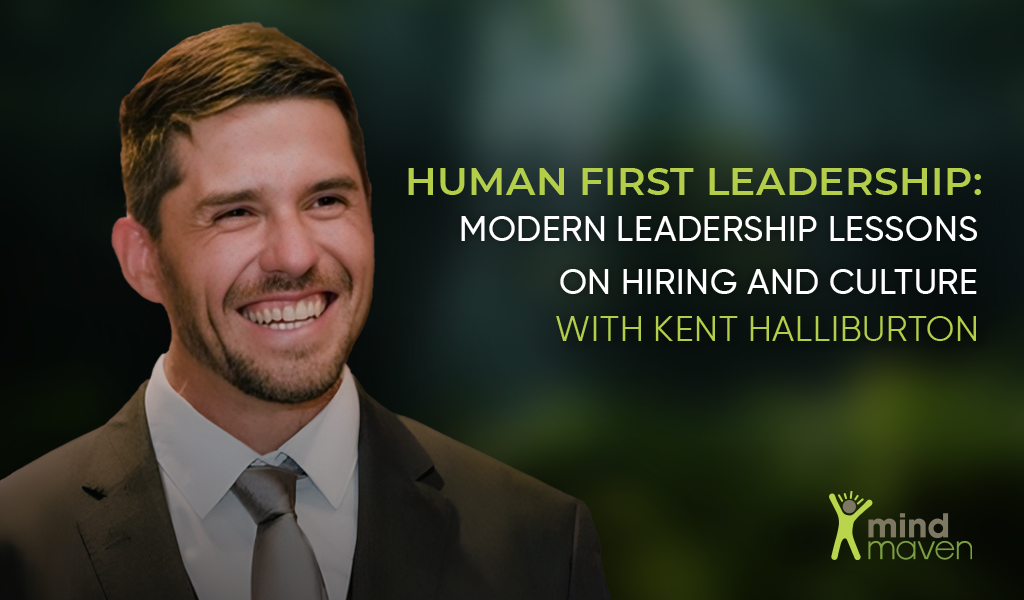
To answer that question, Senior Executive Coach Connor Drake sat down with Kent Halliburton, CEO and co-founder of Sazmining, a renewable-energy-powered Bitcoin mining company.
Kent’s path from computer engineering and solar energy to Bitcoin entrepreneurship has shaped a leadership philosophy grounded in clarity, accountability, and human connection.
Instead of viewing people as cogs in a machine, he sees his team as a tribe built on trust, transparency, and a shared mission.
In this conversation, Kent reflects on the lessons he’s learned building distributed teams across continents, creating cultures of ownership and accountability, and redefining leadership as an ongoing journey of personal growth.
Drawing from Kent’s experience, this reveals essential strategies for building a global tribe through modern leadership lessons on hiring and culture.
Discovering Bitcoin: Kent Halliburton’s Journey to Entrepreneurship
Connor: I wanna get into your leadership and how you’ve built your company. But before we do, why don’t we start with a little bit of background.
How did you first get into Bitcoin and what pulled you into this space?
Kent: I did computer engineering in college and then went into rooftop solar. I mentioned those two things because computer engineering was a core focus on networking there.
Then, rooftop solar. Solar energy was clearly about energy and how the grid works, and those two things wound up being predecessors for understanding Bitcoin quickly.
I took a two-year sabbatical between my rooftop solar degree and the entrepreneurial journey I’m on now, and traveled fairly extensively.
Along the way, I discovered Bitcoin.
I studied Bitcoin and realized the power that it had to be transformative. Wanted to put my shoulder against that particular wheel and help drive adoption.
Eventually, the entrepreneurial journey and my energy background led me to SaaS mining, where we are challenging exchanges for the primacy of how people acquire their Bitcoin.
From “Cogs” to “Tribe”: The Modern Leadership Mindset Shift
Kent: There’s kind of a slowing down that happens with my leadership style to focus on the human-to-human relationships instead of being as focused on people being cogs in a machine that we’re making and growing for the future.
My career in rooftop solar was very much more the former where I saw people is, “Okay, I’m moving people around within the organization to achieve the maximum profitability.”
While that’s important, just having a shift in my time horizons by studying Bitcoin has led to a situation where I think about the relationships I have with these people as:
“Hey, these are part of my tribe and I want to be around these people for a very long time.”
Connor: I’m so glad you used that language of tribe, because I think if you boil humanity down to its core essence, we relational by nature.
That’s a big part of what we teach and preach and coach. It’s rebuilding that tribe. It’s investing into relationships. Seeing people as people, whether it’s team members, it’s your family, or it’s your network.
Building a Distributed Team Across Continents (and Making It Work)
Connor: If I remember right, SaaS mining, you’re a fully distributed team across the US, Europe, South America. Am I remembering that right?
Kent: Yeah, we’re spread out between those three continents pretty equally. Our time zones go from Pacific to Central European, and it works well.
We partner with data centers in different locations right now. The data centers are on three continents, and possibly, by the time this airs, we’ll be in four continents, because we’re looking very closely at Ethiopia at the moment.
Because we have this geographic distribution of our data centers, and our main product is being shipped from China to these data centers. It doesn’t physically have to be a specific location for us to exist in.
When I got into rooftop solar, that was sort of the first career out of college.
Starting from 2005 till now. I’ve never worked in an office environment, so it’s sort of business native for me to work in a remote-only environment.
There’s some things that have to be done to build a culture in that environment. But it’s very much possible to do.
I think that the biggest key that I’ve learned in trying to build a quality culture and team in that environment is the hiring practice has to be absolutely critical to bring the right people in to begin with.
Hiring for Culture Fit in Remote, Mission-Driven Teams
Connor: I’d love to hear about that hiring process. What does that, what does that look like? How do you find people who fit into the culture you’ve tried to build?
Kent: First of all, being in Bitcoin, there’s a lot of people that are mission-driven, right? So that helps.
So we get people that are already, by the time they’re applying, looking at this from a similar value set as the rest of the team. So that’s step one that helps.
Step two is making sure to go through something I didn’t do in my past, but highly recommend is an objective personality assessment.
Some sort of testing criteria that removes any of your personal bias and can let you look at somebody for who they are specifically, and what character attributes they’re going to bring to your team.
It doesn’t mean that person’s hired just by taking a personality assessment, but what it does is it tells me that they’ve got the characteristics of being somebody that would fit on the team.
It was accurate over and over again, and so I just came to rely on that as a screening tool to decide if somebody was a good fit to come into the business.
4 Employee Traits That Predict Success: Goal-Driven, Accountability, Resilience, and Aptitude
Connor: Would you be willing to share maybe some of the green lights that you would look for in a personality test that would indicate this person might be a good personality or cultural fit for the company?
Kent: Yeah, I think, so a couple of attributes that I really look for is one, especially work in a remote-only environment.
1. Goal-Driven
You need to be goal-driven. I don’t want to be surrounding myself with people that I have to task manage, as just an incredible time drain on me, and frankly on the organization too, right?
So, at least the stage growth we are now, maybe that changes in the future, but having people that are driven, to be at work, to be on time to accomplish tasks, and you can screen for that.
2. Accountability
Accountability for the results. I say I’m gonna do X, Y, and Z by the end of the month.
Well, did you do it? If not, do I have to chase you to figure it out if you did or did not? Or are you gonna just show up and say, “Hey, here it is, it’s done ahead of time, or I need some more time.”
3. Resilience to Feedback
I do also like to screen for the ability to give feedback. Some people can take feedback, and there are people who, even with constructive criticism, take it super hard, and it’s very difficult or become very defensive.
And so looking for people that have a greater level of resilience where it can be like, “Hey, cool. Like, no problem.”
You made a mistake on this one. What can you do to do better? And they’re gonna take that and grow from it.
So it’s an indication of being able to grow and have a desire to grow. That’s one that I look for.
4. General Aptitude
Another one I look for is just general aptitude. Making sure when conversations are happening in group settings, the people nod their heads are actually absorbing the information, and can take it away and go execute on what everybody else thought that we were agreeing to.
I think most of us have had the experience of you’re having a conversation with somebody and their head’s nodding and you think, cool, everybody’s on the same page.
They go do something completely different from what we all thought we were agreeing to go do, right?
So, just make sure that there’s a general aptitude and those listening skills are there in a way that the organization can be efficient with, communicate initiatives, and getting them executed.
Modern Leadership Challenges of Managing Global Teams and Expectations
Connor: How difficult for you is it to manage different expectations in different countries for what work and business looks like?
Kent: One of our core values is that we’re a meritocratic organization. We’re a US-based company, as such, the way that we’ve structured everything is kind of traditional meritocratic US values.
At the end of the day, what I think is really critical on this particular point … is you’re not trying to cater for everybody. I think that’s a lost cause.
What you’re trying to do is create a fair set of rules for everybody to play the game of business together in, and, as long as those rules are fair, then people can agree or disagree to play that game with you.
We’re a US-based company, so even though you’re not located there, we’re gonna follow the holiday schedule.
How to Create Transparency in the Workplace: The How I Work Document
Connor: And how do you communicate those rules to someone when they come on board? How transparent are those rules?
Kent: As we grow and scale, I describe that as like the business infrastructure is slowly building out policies and kind of a handbook as things come up.
I think it would’ve been an utter waste of time to have gone off and just created an entire HR handbook and said, this is what we believe in, versus incrementally adding the policies and needs as it became clear.
Like, “Hey, okay, we’ve all been adults here so far as an early stage startup, like let’s just track how much time we’re taking off rather than having a clear like vacation policy and just to make sure that we’re keeping it fair and balanced amongst one another and keeping the business growing to what the set goals and guidelines and expectations are.” So it’s a more adult environment.
Connor: One thing that we’ll talk a lot about with our clients is creating a How I Work document, which is more or less a user guide to the CEO.
How do you interact? What are their expectations? And that should never be a complete document.
It has to evolve over time. And it sounds like you’re saying that the rules of the company and how it operates, those have to evolve over time, as well as expectations they’re identified.
The “Captain in a Storm”: How to Get Employee Buy-In and Respect
Connor: You mentioned that you view people now as your tribe, and I’m curious how do you show that in a day-to-day basis?
What does leadership look like that shows your team that you view them as your people?
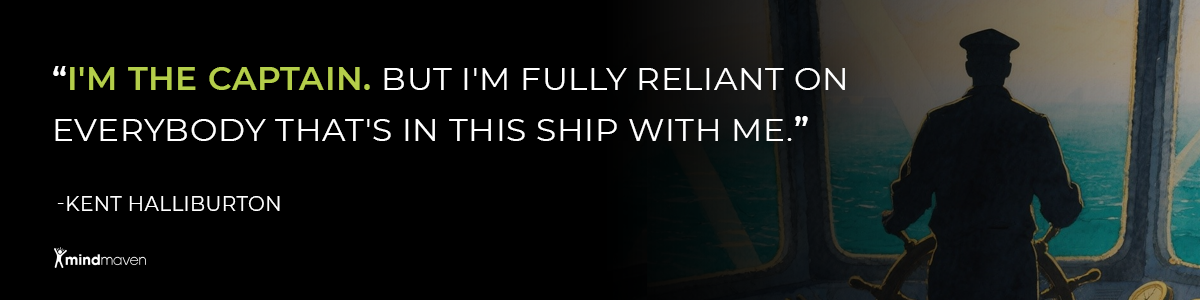
Kent: The metaphor I think of is I’m the captain on a ship. Think of the age of discovery when the first ships were sailing around the globe, right?
We’ve all agreed to be on this boat together, and the laws of physics are dictating the activity on the boat and how we’re sailing.
I’m the captain. But I’m fully reliant on everybody that’s in this ship with me. And for the most part, I want everybody to understand the rules of engagement for their particular role on the ship and to be executing.
I’m gonna be saying, “Hey, we need to go this direction. We need to go that direction.”
But for the most part, it’s on each of them to do their respective roles to make the ship function.
There are certain times though, where the storm comes up. And you gotta batten down the hatches and the captain goes into overdrive and starts shouting orders and everybody starts to listen and just have to do what they have to do.
You have to be willing to take that level of executive authority at the right time. But I believe as a leader, that is inappropriate to be in that mode all the time.
You need to know when it is a survival situation or a critical time and time to start throwing elbows, and telling everybody what to do.
But for the most part, if you’re not giving people consensual opportunity to make decisions and have buy-in with the decisions for their particular role, you’re just going to breed resentment in your organization.
So, treat people with respect and let them do their jobs.
And then if a storm does come up, explain why the storm’s there and what needs to be done to get out of it. And take the reign and people will respect if you’ve given the slack the rest of the time to do their jobs and to get the buy-in, they will respect when you have to come seize the helm and say, “Nope, this is what we gotta do right now.”
They’re good about that. That’s been my experience.
How To Motivate Your Team and Build Accountability in Modern Leadership
Connor: How important is it for you as a leader to provide motivation and fulfillment for the team versus how much of that is on them that they should have that intrinsically?
Kent: I definitely believe in more intrinsic than me being motivated.
I keep a high bar and just have expectations of people. Generally, when you tell people, “I expect this out of you,” people are going to try to rise to that, you know?
Instead of telling people what to do, it’s just like, “Hey man, this is your roles and responsibility. I expect you to do them.”
When people buy on, one of the things that I’m very clear about, again, back to kind of the rules of engagement is, I tell people when I hire them. I’m like, “Hey, look, I’m a lazy boss. I don’t want to look over my shoulder to make sure that you’ve done the thing that you said you’re going to do.”
I expect these things from communications. I expect responses within certain timeframes and setting the rules of engagement and this is the job description. This is what I’m hiring you to do.
This is kind of our contractual agreement between one another.
If you have issues, and when you talk about prioritization, I’m always open to this conversation. So I’m not unfair, but I have a high bar, I guess is is how I look at it.
Generally, A-players love that because it’s clear rules of engagement, and A-players like to push, they like to win.
You just set up the right dynamic and have people that want to win naturally, and you’re going to start winning.
Connor: It’s very succinctly put.
I think if there’s one thing I’m taking away from this, I think the importance of clarity when someone’s coming in, you have a high degree of confidence that they are going to be a fit because you’ve walked them through a personality assessment and matched that with the team.
Clarity on what the company culture is and what the cultural expectations are, and clarity around expectations.
People need to know what is expected of them, and as long as they know that and they opt into it, you are completely safe to hold them accountable to it.
Kent Halliburton’s Biggest Insight on Modern Leadership
Kent: The biggest insight I’ve had in my personal career and it’s now 17 years I think of leadership that I’ve been working on, is that my leadership capability improved the more that I worked on myself.
The single biggest thing that I’ve done that has made me a better leader is to go inwards.
Whatever practices, whatever route you go, the inward journey is going to produce and yield dividends for you in your external reality, as a human and as a leader.
So don’t be scared to go work on yourself because it will wind up producing greater results for you as a leader.
Connor: Beautifully said. I appreciate you adding that as our bookend moment here, and I couldn’t agree more. Thank you, Kent.
The How I Work Document: A Simple Tool for Clarity and Culture
Connor and Kent’s discussion highlighted how building clarity into every layer of leadership, from hiring to project management, is critical to inspiring accountability and team buy-in.
That clarity is only sustainable when supported by the right tools.
Our How I Work Notion template acts as your leadership user manual, providing your team and collaborators with a clear insight into your work style, preferences, and expectations.
By giving your team transparency into how you work, you build trust, loyalty, and efficiency – even in the most distributed environments.
👉 Get your free How I Work template here.
Or, if you’re ready to explore how we can help you scale your company while freeing up 12+ hours every week, book a free call with a Mindmaven coach today: