
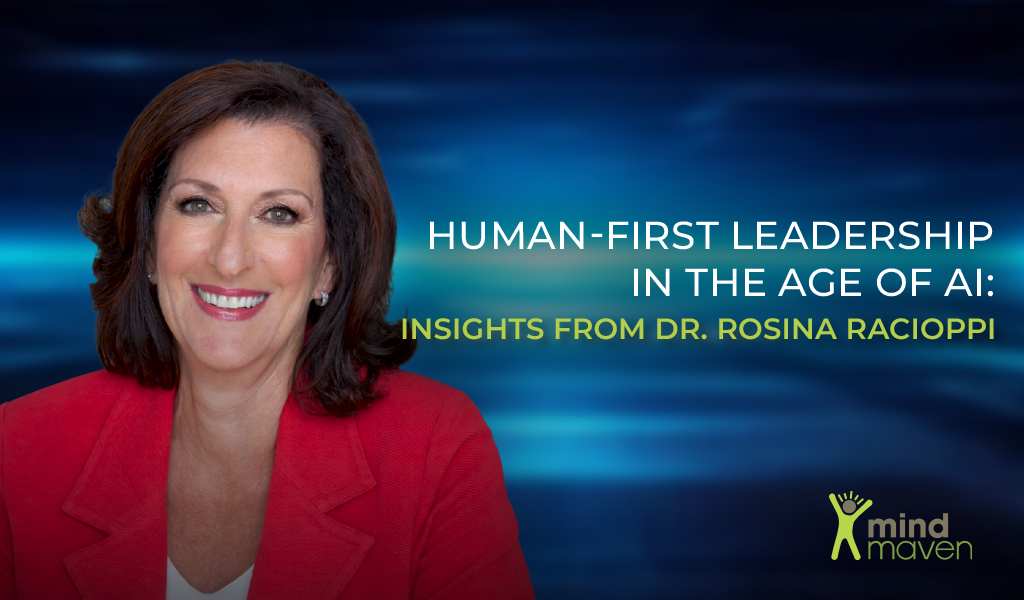
What does leadership look like in a world shaped by artificial intelligence?
For many organizations, the conversation starts with technology. New AI tools promise faster workflows, smarter insights, and unprecedented productivity. Leaders everywhere are asking the same question: How do we use AI to move faster and stay competitive?
But according to Dr. Rosina Racioppi, President and CEO of AscentPoint Leadership, that question may be incomplete.
Because the real differentiator has not changed.
People still determine whether organizations succeed.
In this episode of Human-First Leadership, Mindmaven Senior Executive Coach Lauren Rueve sits down with Dr. Racioppi to explore why leadership development, human capability, and relationships remain the foundation of organizational performance even as AI continues transforming the workplace. The principles of human-first leadership are essential in this transformation.
With more than 25 years advising Fortune 1000 executives, Dr. Racioppi has seen firsthand that technology alone cannot drive results.
Organizations succeed when leaders invest in people.
“AI is a phenomenal tool but it’s still a tool. The real question is how we ensure people have the skills to use it effectively.”
— Dr. RacioppiHuman-first leadership emphasizes the importance of prioritizing people in the age of AI.
Why Human-First Leadership Still Matters in the Age of AI
Artificial intelligence is rapidly changing how companies operate.
Organizations are racing to adopt new technologies, hoping to improve productivity and remain competitive. But Dr. Racioppi believes that the framing of this conversation is often wrong.
“The question shouldn’t be AI versus people,” she explains.
Instead, leaders should ask: How do we ensure our people have the skills to use AI effectively?
Technology can increase speed and efficiency. But without skilled leaders and aligned teams, even the most powerful tools fail to deliver meaningful value.
Leaders must think carefully about questions like:
- How do employees collaborate using AI tools?
- How do we guide AI responsibly and ethically?
- How do we align AI usage with our organization’s values?
Organizations that succeed with AI are not simply the ones adopting the latest tools, they are the ones investing in human capability alongside technological innovation.
The Leadership Challenge of the Modern Workplace: Overwhelm
While AI is reshaping the workplace, Dr. Racioppi sees another defining leadership challenge:
The pace of modern work.
“The speed of business feels like hyper-speed,” she says. “There’s simply not enough time in the day.”
Hybrid work, constant digital communication, and evolving technologies have created a workplace where many leaders feel pulled in multiple directions.
The result?
A state of continuous overwhelm.
When leaders feel overwhelmed, they tend to default to activity.
More meetings.
More messages.
More tasks.
But activity does not always lead to impact.
In fact, excessive activity can distract leaders from focusing on the few priorities that truly move an organization forward.
Dr.Racioppi encourages leaders to stay focused on what is truly critical for the business and its customers.
“When we lose sight of what really matters,” she explains, “we risk getting lost in the noise.”
Activity vs. Connection: A Hidden Leadership Trap
One of the most important distinctions Dr. Racioppi makes is the difference between activity and connection.
When leaders become overwhelmed, they often retreat into execution mode and they try to handle everything themselves.
But effective leadership requires something different.
It requires relationships.
Strong professional relationships provide two critical benefits.
First, they offer perspective.
When leaders build connections across different parts of an organization, they gain a clearer understanding of what is happening within the business.
Second, relationships help leaders anticipate the future.
“If you’re often surprised by what’s happening in your organization,” Dr. Racioppi says, “that means your network is faulty.”
Throughout her career, Dr. Racioppi intentionally built relationships with leaders in operations, sales, and other business functions. According to her, these relationships helped her understand not only what was happening in the organization but also what might happen next.
That insight allowed her to support the business more effectively and prepare for future challenges.
At Mindmaven, we see this same pattern with the founders and executives we coach.
When leaders lack clarity around communication expectations, decision-making styles, or priorities, they often compensate with more activity: more meetings, more emails, more reactive work.
But there is a better approach.
The Mindmaven How I Work Playbook
One of the most powerful tools we introduce to leaders is the How I Work Playbook.
This document clarifies how a leader operates so teams can collaborate more effectively.
It outlines:
- How the leader makes decisions
- How they prefer to communicate
- How they prioritize work
- What helps them perform at their best
When leaders share this with their teams, alignment improves immediately.
Instead of guessing expectations, teams understand how to operate together. Instead of reacting to constant activity, leaders create intentional connection.
For leaders navigating complexity, relationships are not optional.
They are essential.
From Expert to Orchestrator: The Leadership Shift
During the conversation, Dr. Racioppi stressed the importance of one thing: As leaders grow in their careers, their role fundamentally changes.
According to her, early in a career, success is often tied to expertise. You succeed because you know the answer.
But as leaders take on broader responsibilities, their role changes.
They are no longer expected to have all the answers. Instead, they must create environments where the best answers can emerge.
Dr. Racioppi learned this lesson through a powerful piece of feedback earlier in her career. While attending a leadership development program, a colleague told her something that stopped her in her tracks.
“I enjoy working with you,” he said. “But I don’t think I’d want to be in the foxhole with you.”
When she asked why, his answer was direct: “You don’t listen.”
That moment forced Dr. Racioppi to reflect on her leadership style.
She realized that in many conversations, she was listening only to confirm that her perspective was correct.
From that point forward, she changed her approach.
Instead of entering meetings with solutions, she began entering with questions.
“What do you think we should do?”
“How would you approach this challenge?”
Her role shifted from being the problem-solver to becoming the orchestrator of solutions.
And in doing so, she unlocked better ideas and stronger collaboration across her teams.
Curiosity: The Leadership Skill AI Cannot Replace
For Dr. Racioppi, curiosity is one of the most important leadership skills.
Great leaders are not defined by how much they know.
They are defined by their willingness to learn.
One practical way to strengthen curiosity is by paying attention to the questions you ask.
Dr. Racioppi often recommends a short book called Change Your Questions, Change Your Life, which highlights an important distinction.
For her, many leaders unknowingly ask questions designed to confirm their existing viewpoint.
But curiosity requires a different approach.
It requires asking questions designed to learn.
Instead of asking questions that lead to a predetermined answer, try asking:
- “What are the two steps you would recommend we take here?”
- “How do you see this situation unfolding?”
- “What might we be missing?”
These types of questions invite new ideas and unlock perspectives that might otherwise remain hidden.
Curiosity expands the range of possible solutions and in complex environments, that flexibility becomes a competitive advantage.
Feedback: A Simple Practice That Accelerates Growth
Another theme that emerges throughout the conversation is the importance of feedback.
Many leaders hesitate to provide feedback because they worry about making others uncomfortable.
But Dr. Racioppi believes feedback is essential for growth.
It is one of the most powerful accelerators of growth.
Early in her career, one of her mentors practiced a simple but transformative ritual after meetings or projects. They would pause for a few minutes and ask two questions:
- What went well?
- What would you do differently next time?
Those brief conversations created a continuous feedback loop that accelerated learning.
And research supports this approach. A global Gallup study found that the most reliable driver of strong customer satisfaction is managers who provide meaningful feedback consistently.
Yet many organizations still rely on annual reviews instead of regular conversations.
At Mindmaven, we operationalize this idea through a simple but powerful leadership tactic called the Meeting Debriefs.
A Meeting Debrief is a short recap created immediately after a meeting that captures everything that matters from the conversation (especially the commitments made and the context behind them).
Instead of letting valuable information disappear as the day moves on, leaders capture it while the conversation is still fresh. And while the structure is simple, the impact is significant.
As Mindmaven founder Patrick Ewers often emphasizes, most business commitments are made during meetings yet many are forgotten shortly after and Meeting Debriefs solve that problem by ensuring important details and commitments are captured immediately.
The practice can take less than a minute. Some leaders dictate their debrief while walking to their next meeting or record a quick voice memo to process later.
Over time, this simple habit creates a powerful advantage.
Because leaders who consistently capture these insights build stronger relationships, deliver better follow-through, and maintain far greater clarity across their professional networks.
And that aligns directly with Dr. Racioppi’s leadership philosophy: Growth happens through consistent reflection, learning, and connection.
Why Leadership Growth Happens Through Relationships
One of Dr. Racioppi’s most important insights is that leadership growth rarely happens in isolation, it happens through relationships.
Mentors.
Peers.
Coaches.
Thought partners.
These relationships challenge our thinking and help us grow beyond our comfort zone.
Dr. Racioppi encourages leaders to reflect on the people surrounding them and ask themselves these questions:
Am I surrounded only by people who affirm my ideas?
Or do I have relationships that challenge my thinking?
“Growth and comfort don’t coexist.”
— Dr. Racioppi
Leaders who want to evolve must intentionally cultivate relationships that push them forward.
The Future of Leadership Is Still Human
As a parting thought, Dr. Racioppi states one thing: Technology will continue to evolve and AI will become more powerful.
Work will move faster but leadership will remain fundamentally human.
The leaders who succeed in the future will not simply adopt new technologies.
They will:
- cultivate curiosity
- build strong relationships
- create environments where diverse ideas thrive
- develop people who can leverage new tools effectively
Because in the end, organizations do not succeed because of technology. They succeed because of the people who bring that technology to life.
Want to Lead with Greater Impact?
At Mindmaven, we help founders, CEOs, and venture leaders reclaim 12+ hours per week and build high-performing organizations through better delegation, stronger relationships, and proven leadership playbooks.
If you’re ready to elevate how you lead, request a discovery call with a Mindmaven coach today.