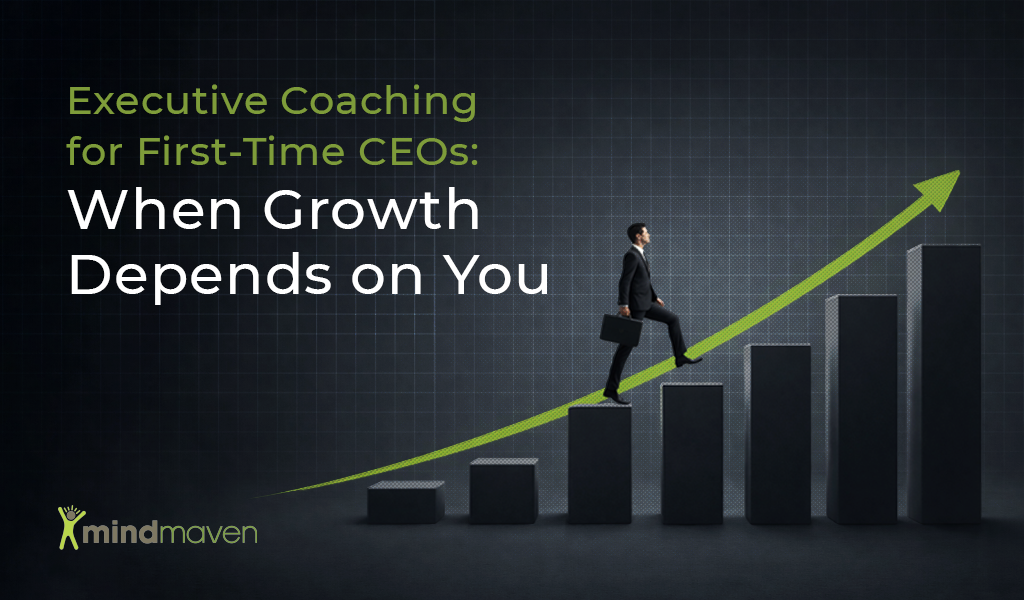
Executive Coaching for First-Time CEOs: When Growth Depends on You is about helping founders recognize and overcome the leadership challenges that limit their company’s potential. Think about this for a moment — when was the last time you had a full day dedicated to strategic thinking?
Not reacting. Not responding. Not catching up. Just thinking.
For most first-time CEOs leading a fast-growing company, uninterrupted time to think is rare. Your calendar fills before your day begins, your inbox dictates your priorities, and even when you block out time for reflection, urgent issues demand your attention. As a result, you spend more energy running the business than shaping its direction.
Here’s the question every founder should ask: What if your biggest growth bottleneck isn’t the team, the market, or the strategy—but the way you’re operating as a CEO?
Many new CEOs reach a turning point where growth accelerates, revenue increases, and the team expands, yet leading starts to feel heavier instead of lighter. Decisions pile up, problems escalate, and progress depends more on you than on the systems around you. This is the moment when executive coaching becomes essential—helping first-time CEOs shift from managing growth to truly leading it.
The Shift: Why Being a Great Founder Is Different From Being a Great CEO
Most founders don’t fail because they lack skill. They struggle because the role changes faster than they do.
As a founder, your job was to build, move fast, solve problems directly and stay close to everything.
As a CEO, your job is different. Your role is no longer to do the work. Your role is to design how the work gets done and this is where most first-time CEO challenges begin.
You’re still operating like a builder in a role that now requires you to be an architect. And that mismatch creates friction everywhere.
- Your time gets fragmented
- Your team becomes dependent
- Your decisions bottleneck progress
This is why executive coaching for CEOs becomes a critical lever. Not because you need more information, but because you need a different way of operating.
The Hidden Bottleneck: When the CEO Becomes the Constraint
CEOs in this stage tend to fall into the same pattern: they become reactive instead of intentional.
Their presence becomes the system.
Their judgment becomes the process.
Their calendar becomes the org chart.
Everything flows through them and when they travel, get pulled into a major project, or simply hit a wall, the entire operation slows down.
This is one of the clearest signals in how to scale as a CEO: If your business cannot move without you, it is not built to scale.
One CEO I worked with had a team that genuinely believed quality would slip without her in every conversation, and the business had been built in a way that made that feel true.
She had built a company that literally could not function at full capacity without her in every conversation. She loved the work, but she was in year 20 and the team wanted more while she needed to do less.
They were speaking different languages.
That tension, wanting to stay close to the work while knowing you cannot keep doing more, is the exact identity shift most coaching programs skip over.
Delegation frameworks and calendar audits treat surface-level symptoms while the underlying shift goes unaddressed.
Scheduling tools and org charts will not close that gap either.
It is a question of who you believe you need to be for this company to succeed.
What Mindmaven’s Executive Coaching Actually Changes
At this point, most CEOs try to solve the problem tactically.
They try better tools, they try new systems and they try to delegate more.
But none of it sticks because the issue is not tactical. It is structural and behavioral.
This is where executive coaching for CEOs becomes non-negotiable.
Not as support but as the mechanism that rewires how you operate.
Because if your presence has become the system, then the work is to build a system that no longer depends on your presence and that requires changes at multiple levels.
1. It Rewires How You Think About Your Role
Most first-time CEOs are still asking: “How do I stay on top of everything?”
Coaching shifts the question to: “What should only I be responsible for and what should never depend on me again?”
This is where the identity shift happens.
You stop measuring yourself by how involved you are and start measuring yourself by how independent your team becomes. Without this shift, every system you try to build collapses back into you.
2. It Rebuilds How You Allocate Your Time
Right now, your calendar is likely a reflection of demand.
What people need from you, what shows up, what feels urgent and coaching helps you turn your calendar into a reflection of intent.
You begin to:
- Define what deserves your time
- Remove yourself from what does not
- Create protected space for thinking and decision-making
This is not just about productivity. This is about making sure your time matches the level your company needs you to operate at.
If this does not change, nothing else scales.
For a deeper look at how this plays out in practice, you can read more in an article we have written here.
3. It Changes How Decisions Move Through the Company
In most early-stage companies, decisions move through the CEO and that works until it does not.
Coaching helps you redesign decision flow.
You begin to:
- Define who owns which decisions
- Create clear decision frameworks
- Build trust in your team’s judgment
The goal is simple: decisions should move at the speed of the business, not the speed of your availability.
4. It Turns Your EA Into Leverage, Not Support
Most CEOs underutilize their Executive Assistant. They use them for coordination, not leverage and the right coaching changes that.
Your EA should become part of your operating system.
When leveraged properly, a skilled EA can help you:
- Pre-process information before it reaches you
- Draft communication so you are refining, not creating
- Manage your calendar based on priorities, not requests
- Ensure follow-through across everything that matters
This is where CEOs start reclaiming 10 to 12+ hours per week – not by doing less randomly, but by removing themselves from the wrong work systematically.
5. It Builds Leadership Capacity as Infrastructure
This is the part most people miss.
Leadership capacity is not a personality trait, it is an infrastructure.
Through coaching, you build:
- Systems that reduce cognitive load
- Relationships that increase alignment
- Space that allows for strategic thinking
The CEOs who make this shift often describe the same moment: they step away and the business keeps moving.
That is not luck, that is infrastructure working.
So Where Does AI Actually Fit Into This?
If your presence has become the system… what happens when you add AI on top of that?
Most CEOs are already trying. They are experimenting with tools, testing prompts, automating pieces of work.
But here is what usually happens.
AI speeds things up but it does not remove the bottleneck.
Because everything still routes through you.
You still review everything, you still decide everything, and you are still the system.
So instead of leverage, you get more output to manage.
More drafts, more summaries and more noise.
The Real Shift: AI Only Works When the System Changes
At Mindmaven, we do not treat AI as a tool layer. We treat it as part of your operating system.
Because we strongly believe that AI should not create more work. It should remove you from the wrong work.
What This Looks Like in Practice
- Dictation instead of drafting: Instead of typing everything yourself, you think out loud, AI structures it and your EA refines it. It then becomes usable output and you can see yourself move faster with less effort.
- Meeting debriefs that do not depend on you: AI captures and summarizes while your EA organizes and routes. This way, decisions and follow-ups move forward without you holding everything in your head.
- Inbox systems that reduce your involvement: AI drafts, your EA prioritizes and edits and you step in only where necessary. You are no longer managing communication. You are directing it.
This is the difference.
AI does not replace the role of your EA, it reinforces the system you build. And if the system still depends on you, AI will too.
Growth Is Not a Time Problem. It Is a Leadership Systems Problem
Most first-time CEOs try to solve this by working harder but more effort does not create leverage.
A better system does.
Your job is no longer to keep up with growth but to build the system that allows growth to happen without you being the center of everything.
That is what executive coaching for CEOs is designed to help you do.
Build the System That Frees You
If you recognize yourself in this, you are not alone.
And you are not stuck.
With the right systems, support, and coaching, you can:
- Reclaim 12+ hours per week
- Make better decisions with less effort
- Build a team that operates independently
- Create space to actually lead
At Mindmaven, we help first-time CEOs redesign how they work, build systems that remove them as the bottleneck, and integrate AI into workflows that actually create leverage.
👉 Book a free 1:1 call with Mindmaven and start designing how your business runs without everything depending on you.