
Growing a company creates a paradox.
The more successful a founder, CEO, or executive leader becomes, the more decisions seem to flow directly toward them.
That’s why decision-making coaching for senior executives, the leadership system that frees 12+ hours every week, has become increasingly valuable for leaders navigating rapid growth. Not because executives suddenly forget how to make good decisions, but because scaling organizations create more complexity, more requests for input, and more demands on leadership attention than any one person can sustainably manage.
What starts as strategic leadership gradually turns into operational bottlenecking.
Calendars become crowded. Slack notifications never stop. Team members wait for approvals. Meetings multiply. Important decisions compete with urgent requests. And despite working longer hours, many leaders feel they have less time to think than ever before.
The challenge isn’t decision quality.
It’s decision architecture.
Why Senior Executives Become Decision Bottlenecks
Most executives don’t intentionally become bottlenecks.
It happens gradually.
As companies scale, complexity increases faster than leadership systems.
A founder who once managed ten people may suddenly oversee fifty. A COO who previously handled a straightforward operation now manages multiple departments. New managers require guidance. Cross-functional decisions become more frequent.
Without intentional systems, executives become the default escalation point.
This creates three common problems:
Decision Fatigue
Research consistently shows that decision quality declines as cognitive load increases.
When leaders spend their day approving minor requests, reviewing operational details, and responding to constant interruptions, they have less mental bandwidth available for strategic thinking.
The result is slower decisions, lower-quality decisions, and increased executive stress.
Delayed Organizational Speed
Many growing companies assume they’re moving slowly because they need better people.
In reality, they’re moving slowly because too many decisions require executive involvement.
When teams wait for approvals, alignment, or clarification, execution stalls.
Founder and Executive Burnout
Founder burnout is often discussed as an emotional challenge.
More often, it’s an operational challenge.
Leaders become overwhelmed and exhausted because they’re carrying responsibilities that should have been systematized, delegated, or distributed throughout the organization.
The problem isn’t effort.
The problem is design.
The Hidden Leadership Problem Most Executive Coaching Misses
Traditional leadership coaching often focuses on communication, confidence, emotional intelligence, or executive presence.
These skills matter.
But they don’t solve operational overload.
An executive can become a better communicator and still spend ten hours per week managing calendar conflicts, chasing information, and making low-leverage decisions.
That’s why executive coaching for CEOs and senior leaders must address how work flows through the organization.
Leadership effectiveness is rarely limited by capability.
It’s often limited by capacity.
And capacity is created through systems.
Why Scaling Companies Struggle Without Leadership Systems
Many companies outgrow their original operating model long before they realize it.
The founder remains involved in every major initiative.
Department leaders depend on executive approval.
Meetings become the primary coordination mechanism.
Information lives in multiple places.
Priorities shift constantly.
Eventually, the company reaches a point where growth creates friction instead of momentum.
The Symptoms Are Easy to Spot
- Leadership teams spend more time coordinating than executing
- Strategic projects move slowly
- Teams repeatedly escalate routine decisions
- Executives feel overwhelmed despite hiring additional staff
- Meetings consume increasing portions of the week
- Organizational alignment becomes harder to maintain
The Root Cause Is Less Obvious
Most organizations don’t have a people problem.
They have a leadership systems problem.
Without intentional decision frameworks, delegation structures, and communication pathways, every growth stage adds complexity.
And complexity always seeks executive attention.
The companies that scale most effectively build systems that reduce leadership dependency rather than increase it.
What Decision-Making Coaching Should Actually Focus On
Executive leadership development should help leaders improve not only how they think, but how decisions move throughout the business.
This requires examining four key areas.
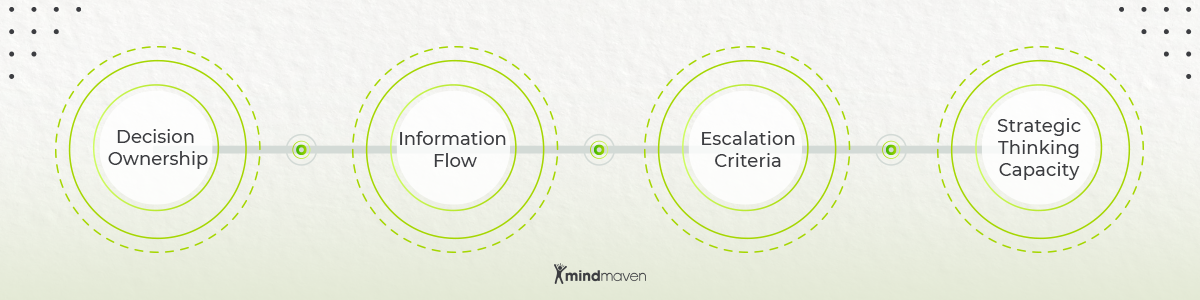
Decision Ownership
Every recurring decision should have a clear owner.
When ownership is unclear, teams escalate unnecessarily.
Strong leadership systems establish who decides, who advises, who executes, and who stays informed.
Information Flow
Executives often receive information either too late or in overwhelming quantities.
Neither approach supports effective leadership.
Decision-making coaching should help leaders create predictable information pathways that surface critical issues without creating constant interruptions.
Escalation Criteria
Not every issue deserves executive attention.
Organizations need clear criteria for determining what gets escalated and what remains with the team.
When escalation standards are unclear, everything feels urgent.
Strategic Thinking Capacity
Senior executives create the most value when focusing on direction, priorities, resource allocation, and organizational alignment.
Protecting time for strategic work requires reducing involvement in lower-leverage activities.
The Executive Assistant Advantage Most Leaders Underestimate
One of the most overlooked drivers of operational efficiency for executives is the Executive Assistant relationship.
Many leaders view their EA as administrative support.
High-performing executives view their EA as an operational partner.
The difference is significant.
At Mindmaven, we’ve seen that executive coaching becomes dramatically more effective when it includes Executive Assistant alignment.
Why?
Because behavior change is difficult to sustain alone.
Systems change is easier to maintain when a trusted partner helps reinforce it.
Executive Assistants Create Decision Leverage
An aligned Executive Assistant can help:
- Filter and prioritize incoming requests
- Identify decision patterns
- Protect strategic thinking time
- Improve meeting effectiveness
- Reduce unnecessary interruptions
- Coordinate follow-through across teams
- Surface critical information at the right moment
This transforms the executive role.
Instead of reacting constantly, leaders operate more intentionally.
Better Partnerships Create Better Leadership
The strongest executive-EA partnerships function as a leadership operating system.
Together, they create clarity around priorities, communication, delegation, and decision-making.
This is one reason Mindmaven’s coaching approach consistently helps leaders reclaim 12+ hours each week.
The gain doesn’t come from productivity hacks.
It comes from redesigning how leadership work happens.
Delegation Is a Leadership System, Not a Leadership Skill
Many executives believe they struggle with delegation because they need to trust their team more.
Trust can be part of the issue.
But delegation failures are often structural.
Leaders frequently delegate tasks without delegating authority, context, or decision rights.
As a result, work returns to them repeatedly.
Effective delegation systems include:
Clear Outcomes
Teams need clarity on what success looks like.
Decision Boundaries
People need to know which decisions they can make independently.
Accountability Mechanisms
Progress should be visible without requiring constant executive oversight.
Executive Assistant Coordination
An aligned Executive Assistant can monitor commitments, identify bottlenecks, and ensure follow-through without requiring the executive to manage every detail personally.
When these elements exist, delegation scales.
Without them, executives remain trapped in operational work.
What High-Performing Leadership Teams Do Differently
Organizations that scale successfully share a common characteristic.
They reduce dependence on individual leaders.
Their executives focus on strategic leadership rather than operational firefighting.
They create:
- Clear decision frameworks
- Consistent communication systems
- Strong Executive Assistant partnerships
- Defined escalation pathways
- Leadership accountability structures
- Protected strategic thinking time
As a result, they move faster with less executive strain.
This isn’t accidental.
It’s designed.
The Future of Executive Coaching Is Operational
The demands on today’s leaders continue to increase.
More communication channels.
More complexity.
More stakeholders.
More decisions.
The solution isn’t working harder.
It’s building better systems.
Executive coaching for CEOs and senior leaders must evolve beyond individual performance improvement.
The most impactful coaching helps leaders redesign how they work, how decisions move, and how support systems function around them.
When leadership systems improve, organizational performance improves.
And when executives build stronger partnerships with their Executive Assistants, they create leverage that extends far beyond calendar management.
They create capacity.
Capacity to think strategically.
Capacity to lead effectively.
Capacity to scale sustainably.
Frequently Asked Questions
What is decision-making coaching for senior executives?
Decision-making coaching helps senior leaders improve how decisions are made, delegated, communicated, and executed throughout an organization. It focuses on reducing bottlenecks, improving strategic thinking, and creating leadership systems that scale.
How does executive coaching help CEOs save time?
Executive coaching helps CEOs identify operational inefficiencies, strengthen delegation systems, improve leadership workflows, and build better Executive Assistant partnerships. These improvements can free significant time each week for strategic work.
Why do founders become decision bottlenecks?
Founders often become bottlenecks because organizational systems fail to scale alongside company growth. Teams continue relying on the founder for approvals, direction, and problem-solving, creating dependency and slowing execution.
How does an Executive Assistant improve leadership effectiveness?
An Executive Assistant can improve leadership effectiveness by managing information flow, protecting executive focus, coordinating priorities, reducing interruptions, and helping maintain operational systems that support better decision-making.
What is the connection between delegation and executive coaching?
Executive coaching often helps leaders build delegation systems that distribute responsibility effectively. Strong delegation increases team ownership, improves organizational speed, and reduces executive overload.
What should executives look for in leadership coaching?
Executives should look for coaching that combines leadership development with practical operational improvements. The most effective coaching addresses decision-making, delegation, communication systems, and organizational effectiveness—not just leadership theory.
Create More Leadership Capacity Without Working More Hours
The most successful executives aren’t necessarily making better decisions than everyone else.
They’re creating environments where fewer decisions need their attention.
At Mindmaven, we help leaders reclaim 12+ hours every week by improving how they work with their Executive Assistant, strengthening delegation systems, and building leadership structures that scale.
Because sustainable leadership isn’t about doing more.
It’s about designing a better way to lead. Book a call today to learn how executive coaching for CEOs and senior leaders can create more strategic time, stronger delegation systems, and sustainable operational leverage.