At some point, every successful founder faces a question most never prepare for: What if I’m no longer the right CEO for the next stage of the company?
Not because they failed but because they succeeded.
The skills that take a company from zero to one (vision, speed, instinct), are not the same skills required to scale it into a global, operationally complex organization. And yet, many founders try to stretch themselves into that next phase, often at the company’s expense.
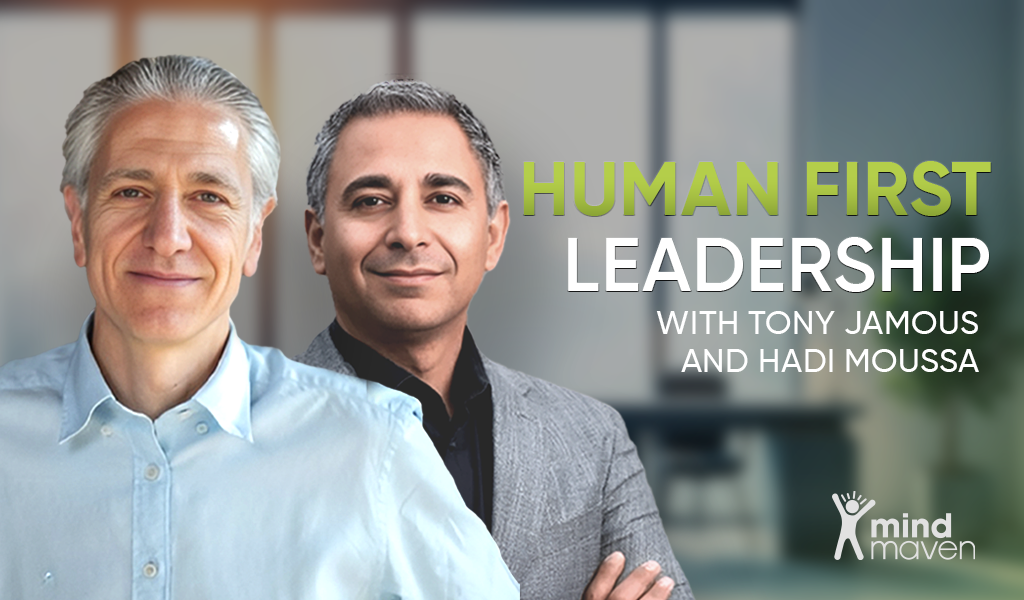
In a recent conversation on our Human-First Leadership Podcast, Mindmaven Executive Coach Lauren Rueve sits down with Tony Jamous (Executive Chairman, Oyster) and Hadi Moussa (CEO, Oyster) to unpack a rare kind of transition: Tony intentionally stepped down as CEO and handed the reins to Hadi, from a position of strength.
This wasn’t reactive nor forced.
It was designed.
And in that decision, a deeper truth becomes clear: Leadership doesn’t scale automatically. It has to evolve.
Intentionally, structurally, and personally.
It Starts With a Shift in How You See People
Before strategy, structure, or scale, both leaders anchor on something more fundamental: How you see your team.
According to Hadi, human-first leadership begins with recognizing that people are not just resources to optimize. They’re whole individuals with lives, ambitions, and realities beyond work.
But this isn’t about being a “softer” leader.
It’s about building an environment where psychological safety and high performance reinforce each other, instead of competing.
Tony Jamous builds on this by turning the lens inward.
For him, human-first leadership starts with self-leadership:
- Staying non-reactive
- Staying aligned with your values
- Staying consistent in how you show up
Because ultimately, culture isn’t defined by what leaders say.
It’s defined by what their behavior allows.
And that foundation becomes critical as complexity increases.
The Moment Where Leadership Breaks or Evolves
As Oyster scaled, a clear inflection point emerged.
Tony recognized that the skills required to build the company were no longer the same skills required to run it at scale.
As Oyster grew into a more complex, global organization, the demands of leadership shifted:
- From instinct to systems
- From building to executing
- From speed to operational rhythm
At that point, Tony faced a real decision. He could try to learn and stretch into this next phase or he could redesign leadership around what the company actually needed.
He chose the latter.
Not because he couldn’t grow into the role, but because doing so might have slowed the company down or put it at risk.
That decision reflects a rare level of clarity: scaling a company sometimes means stepping out of the way.
Transitions Only Work When They’re Designed Early
What makes this transition different is that it wasn’t reactive. It was intentional, and it started well before the handoff.
Tony focused on:
- Structuring the organization for scale
- Ensuring the right leadership team was in place
- Waiting until the business was performing strongly
Timing, in his view, was everything and equally important was how the next CEO was chosen.
Instead of relying on instinct or familiarity, the role was defined using 360-degree feedback from the team, ensuring the decision reflected what the organization actually needed next.
That level of intentionality created something most transitions lack: Trust in the process, not just the person.
Why This Didn’t Feel Like a Replacement
Even with the right timing and process, transitions often create uncertainty.
That’s where Hadi Moussa’s framing becomes critical. According to Hadi, the most important thing was reinforcing what doesn’t change:
- The mission
- The values
- The long-term direction
He describes the transition not as a replacement but as a relay race.
The runner changes but the destination doesn’t.
And this idea connects directly back to how the transition was communicated.
Transparency Isn’t About Saying Everything
Both leaders are clear: transparency matters but only when done well.
Tony emphasizes the importance of timing and audience by sharing the right information with the right people at the right moment to avoid confusion or unnecessary disruption.
Hadi builds on this by clarifying what transparency actually means in practice.
For him, it’s not about sharing every detail. It’s about clearly communicating the why behind decisions.
Because when people understand intent, they don’t just receive information.
They align with it.
And that alignment is what makes a transition feel steady, even when things are changing.
Purpose Creates Urgency and Direction
One of the most personal moments in the conversation comes when Hadi reflects on his own background.
Having experienced firsthand how access to opportunity can depend on where you’re born, he explains that Oyster’s mission is deeply personal to him because of this.
That connection does more than inspire. It creates urgency.
In his view, every day the company doesn’t move forward, is a missed opportunity for someone, somewhere, to access work they otherwise couldn’t.
That urgency connects directly back to his leadership because for him, as companies scale, clarity of purpose becomes a driving force behind execution, not just culture.
AI: Not Replacing Humans, Just Refocusing Them
As the conversation shifts to AI, the perspective remains consistent: technology should enhance, not replace, the human element of work.
According to Hadi, AI is most valuable when it removes repetitive, operational tasks such as freeing up time for leaders and teams to focus on what actually matters: relationships, decision-making, and complex problem-solving.
But there’s an important nuance.
AI only creates leverage when the underlying systems are clear.
Without structured workflows, strong communication, and intentional delegation, AI doesn’t simplify work, it amplifies confusion.
Which reinforces a broader point: Technology scales whatever leadership already exists—good or bad.
Leading Under Pressure: What Actually Changes Behavior
As the discussion moves into how leaders operate under pressure, the ideas begin to converge.
Hadi emphasizes two key shifts:
First, overcommunicating context instead of instructions: helping teams understand why decisions are made, rather than telling them exactly what to do.
Second, assuming positive intent especially in distributed teams where context can easily be lost.
These principles aren’t just communication tactics.
They’re ways of preserving trust and autonomy when pressure would normally push leaders toward control.
Tony complements this with a mindset shift of his own.
He said that when he’s faced with challenges, he focuses on reframing them, not as setbacks, but as redirections.
That perspective helps maintain composure and clarity: two qualities that become even more important as complexity increases.
The Bigger Shift: Leadership in a Borderless World
As the conversation comes full circle, both leaders point to a broader transformation already underway.
According to Tony, AI is helping decouple opportunity from location, making it possible for people to contribute meaningfully regardless of where they are in the world.
Hadi extends this further by saying that companies themselves can now be built from anywhere, powered by global talent and enabled by technology.
And in that world, the advantage is no longer just access to talent.. it’s how well that talent is led.
Final Thought: The Leadership You Need Next
If there’s one thread that connects everything in this conversation, it’s this: Leadership is not static and the cost of not evolving it compounds over time.
According to both Tony and Hadi, great leadership requires continuous shifts:
- From vision to execution
- From control to trust
- From doing to enabling
But the core responsibility remains the same: To build systems, cultures, and relationships where people can do their best work.
Not just productively but meaningfully.
Ready to Rethink How You Lead?
If this resonates, it may be time to look at your own leadership differently, not just in what you do, but in how you scale it.
At Mindmaven, we help founders and executives:
- Reclaim 12+ hours per week
- Build stronger executive partnerships
- Scale leadership through systems and playbooks
👉 Book a free call with a Mindmaven coach and start building a more human, high-performing organization.